 |
| Outside Santo Tomas Church in Chichicastenengo, Guatemala |
Friday, April 13, 2012


Revisiting Guatemala 21 Years Later
 |
| Posters on the Guatemala City walls are reminder of those who "disappeared" during the civil war |
Going back to Guatemala 21 years
after my first visit brought back a lot of memories.
In 1991, me, a college student
specializing in Central American human rights, went off to study Spanish in
language school in Quetzaltenango (Xela), Guatemala's 2nd largest city.
At that time the country was deep in an ongoing civil way that began in 1960
and tore the country apart with opposition guerrilla fighters trying to take
down a brutal military regime. Death squads killed "more than 200,000
people died and nearly 50,000 went missing." (pri.org) After having
visited 6 months before Nicaragua and seeing their post-revolutionary society I
had studied so much, I once again realized how much one can learn first hand in
travel and headed to this other country that I was also learning so much about.

Semana Santa in Guatemala
 |
| Processions went from early mornings and to at night. |
This year I decided to celebrate holy week in a totally
different way. I left Easter bunnies and baskets behind and
headed to Guatemala where deep Catholic traditions reign and big festivities
commemorate the significant events of the week.
In Antigua, the well preserved colonial capitol, the week is
filled with large religious processions. Different churches and their
congregations carry floats and effigies of Jesus, Mary and other saints through
the streets. 1000s participate in each and walk for hours as they wind
through all the streets. Multiple processions happen each day.
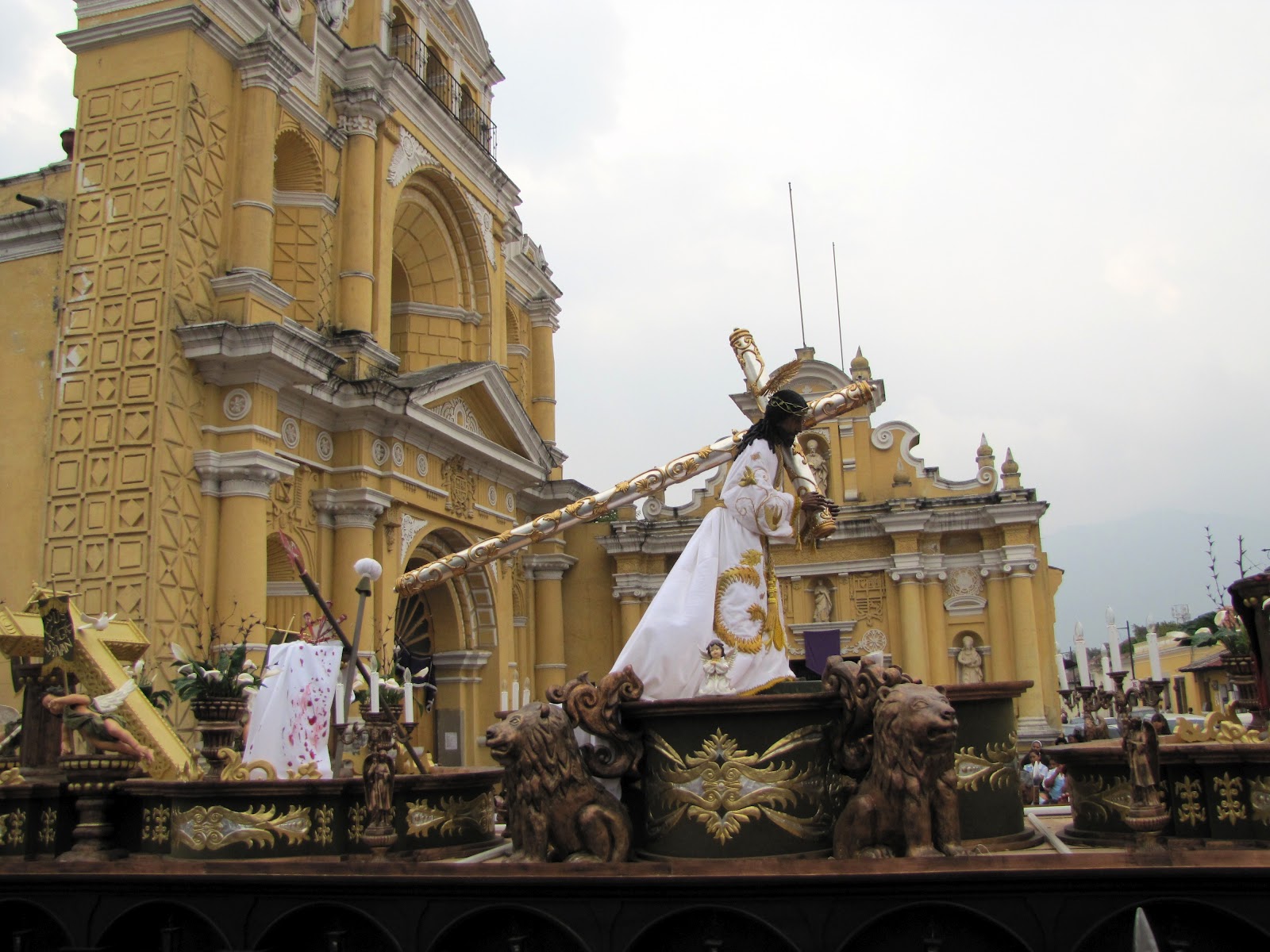 |
| The main floats weigh up to 7000 pounds |
I had no idea what to expect and frankly am still
overwhelmed by the grandeur of it all.
In some processions, people act out
the important scenes and on the first day, we arrived just in time to watch an elaborate reenactment of Jesus getting sentenced
to death. It was a pretty dramatic
start and made me relive the other steps along Jesus' route to crucifixion and resurrection in a
way I never have before in years of Easters in the US.
 |
| Christ has risen! |
I woke up on Easter Sunday to the sound of church bells and
anxiously waited for the Easter procession where a risen and glowing Christ
would be paraded through the crowd as if he was really alive. That
procession did not disappoint. Jesus was guided by brightly dressed kings
and shepherds and a cheering crowd greeted them along the way. Jesus was
followed by a happy marching band that filled the air with joyous music which
was a nice change from the somber marching music that accompanied processions
on Maundy Thursday and Good Friday.
 |
| Saw dust carpets like this covered the streets |
Alfombras (carpets)

One component of the celebration that is different from
anything I have ever seen before was the alfombras or carpets that local people make for the processions to walk on. These carpets are made of colored
saw dust or pine needles and covered with flowers, fruits and vegetables.
The patterns are elaborate and communities plan the designs throughout the year
and get together to create the carpets in the 12 hours before a procession
passes through. Some of them line full streets. Many have religious
designs. All are colorful and a feast for the eyes and give tourists a
locals a reason to wind through the streets all day every day and see what is
being created. It’s incredible to see the amount of work these temporary
gifts to Jesus take to make and then to watch them get walked over in the
processions and quickly swept up by the sanitation crew at the end of the
procession. I worked on one and felt proud to see it finished and pained
to see it stomped on.
I kept thinking someone should start art festival in New York where people created sawdust carpets like these. The art work was amazing in Guatemala so I can only imagine the creative ways my favorite New York street artists would design.
At the end of Semana Santa, I left Guatemala with the desire to learn more about these celebrations that exist all over Latin American and Spain. Maybe my new Easter tradition will be following religious processions, wherever I can find them?

Thursday, April 12, 2012

Thursday, January 26, 2012
The Singapore Zoo
 |
| I don't get to go to Madagascar this year but I did get to meet some lemurs |
While I was in Singapore I got to visit the zoo. Its a pretty incredible place all around. They have managed to take down many of the usual fences that separate visitors from the animals so people can get really close to some of the animals. This lemur was in the rainforest section. He is used to being surrounded by humans and pretty much ignored me and let me look him right in the eyes from a few inches away. Amazing! Just amazing!
Wednesday, January 25, 2012
Photos from Singapore
 |
| Scenes of Singapore |
On the way home from Indonesia, I decided to stop over for a few days and experience Singapore.

Tuesday, January 24, 2012
A Short Indonesia Tutorial

Indonesia is:
- the world's 4th most populous nation with 238 million people.
- the largest Islamic nation where 86% of its population is Muslim, though Christianity still has a strong hold on some of the islands that were colonized by the Dutch and Portuguese in the height of the spice trade. Also Bali, the most popular tourist destination in the country, practices Hinduism.
- made up of over 17,000 islands, about 6,000 of which are inhabited. As one flies over Indonesia's waterways, you look down and see speckled below lovely little spots of land wrapped with white white sand and a ring of deep blue water and dream about tropical paradise. I visited Java, the central island, where over half of Indonesians live. It’s the world's most densely populated island. I also went to Sulawesi, Bali, Lombok and the Gili Islands. (Before I went everyone would ask, which islands I was going to and the question would seem overwhelming, but after a trip there the main islands roll off your tongue easily. One of my favorite outcomes of travel is the way the unusual becomes usual and then I can read and understand places and things so much better when I return home.)
- located, in simple terms, below South East Asia and above Australia, along the Equator.
Memories of Indonesia
Now that I have traveled to so many places, its hard to wow me. Instead I try to enjoy the simple pleasures and slower paces of places. In Indonesia, that means:
-hearing Islamic call to prayer echoing from multiple mosques over ripe lush green rice fields in Lombok as the sun sets
-seeing how coffee, cashews and cocoa are harvested in different villages sprinkled among other crops, trees and houses at different climates and altitudes than I've seen before
-hearing Islamic call to prayer echoing from multiple mosques over ripe lush green rice fields in Lombok as the sun sets
-seeing how coffee, cashews and cocoa are harvested in different villages sprinkled among other crops, trees and houses at different climates and altitudes than I've seen before
Monday, January 23, 2012
 |
| In Bali there are many little Hindu temples where people leave daily offerings to a variety of deities |
Thursday, January 12, 2012
The Beaches of Bali and Lombok
 |
| The beach at Gili Air |
Bali is lovely. I'm not sure it is an untouched as I may have thought before. There are plenty of tourists and hotels... but the beach I just visited, Sanur, is smartly developed with a brick walkway all the way up the coast for perfect morning walks and enough, but not too many, bars along the way to get fresh juice or a Bintang depending the time of day.
Sunday, January 08, 2012
Feeling like a Superstar in Indonesia

I think the bombardment is more here because it seems like Indonesia has a swelling middle class and with that many many more people with cameras who want my moviestar like mug on them.
All I can say it is was loads of fun and now that I have reached touristy Bali where I am just another common looking face, I miss it.
Saturday, January 07, 2012

Farewell 2011, its been great. - My 2011 Holiday Letter

Yes, here as 2011 closes, I'm off on another travel adventure. So far its great and filled with new experiences. You can check out my blog to see my thoughts and photos.
2011 has been a good year for me. I got to travel for work to Ethiopia, Ghana and Kenya and then for pleasure to China and North Korea (made even more interesting by Kim Jong-il's recent passing.) I got to spend time visiting friends in the US too and finally saw the much loved Asheville, NC, explored more of Detroit and revisited Martha's Vineyard after too long.
Wednesday, December 28, 2011
Java Travels
I'm writing from a steamy train looking out the window at rice field
after rice field in a glowing green. Every inch of Indonesia seems to
be cultivated with something or crowded with houses and traffic filled
roads. In the last few years as the economy here has grown many people
have bought motorbikes and they crowd the roads and weave in between the
cars. The roads and infrastructure can't handle it all and its made
for some extra long rides for us, especially since its the holiday
season and school is off so people are on the go. On the bright side
this means that we get to join them at the local sights which can be
quite fun since for some reason many people ask to take photos with us
like we are some exotic creature. It feels fun to be special! Plus
Indonesians have wonderful big smiles and endlessly giggle which is
infectious and the inevitable response to a photo session.
Saturday, December 17, 2011


Friday, December 16, 2011
Exploring the Culture of Tana Toraja
 |
| A typical Torajan compound |
The great thing for a low budget traveler like me is that in Tana Toraja I could afford hire a guide, jump on the back of his motorbike and go off and learn about the culture. I heard so much over my 5 days there that I am a bit afraid to even attempt to repeat it for fear of inaccuracies but here goes.
Torajans are renowned for their elaborate funeral rites, burial sites carved into rocky cliffs, massive peaked-roof traditional houses and colorful woodcarvings. Toraja funeral rites are important social events, usually attended by hundreds of people and lasting for several days.
 |
| The funeral procession |
I was able to attend two funerals and see different rituals. Day one is for receiving guests and gifts. This meant an elaborate ceremony where all the guests are honored and led in a procession around the courtyard by the family of the deceased. Although on a daily basis the extent of traditional dress in Tana Toraja is more like jeans and a t-shirt on the first day of the funeral everyone is decked out in their finest Torajan clothes. Each guest or family has brought a gift which often is a live pig or water buffalo. These gifts are displayed in the courtyard and recorded and announced in a ceremony to the crowd.
 |
| A display of buffalo horns from funerals |
 |
| The sacrifice!!! |
Throughout these two days I kept having to pinch myself to prove I was really there. The enormity of the celebration and the total "Wow, I'm having a National Geographic moment" was incredible. Torajans have realized that tourists are interested in their traditions and welcomed us with open arms and bright smiles. On each day there were a small handful us but comparing that to the 1000 local attendees were certainly did not affect the spirit of the celebration.
 |
| Lemo cliff graves |
The Graves
On the last day of the funeral the casket is placed in the family tomb. Over hundreds of years, Torajans have been carving graves in stone cliffs, caves and building elaborate mausoleums that look like little individual houses bigger than many New York apartments. The deceased is buried with some valuable possessions and ancestors continue to leave offerings at the side of the these tombs. Family members are often entombed together over the years. The idea is that the spirit will live on. Some tombs also have tau tau effigies with them that represent the people who were placed there.
The Weekly Livestock Market
 |
| The buffalo market |
Pigs on the other hand aren't treated as nicely. Small ones are kept in grain sacks which are opened for prospective buyers to peer into. Larger pigs are strapped to bamboo sticks so that they lie flat all day on display. Watching the process of tying them down was painful. They squeal and kick. I must say though I like pigs even better after watching them. They are fighters. They kept kicking as if they really believe they could set themselves free and save themselves from their inevitable death. (The buffaloes at the funeral just stood passively at the funeral as others beside them were slaughtered. They stood in pools of blood and had no reaction at all.)
 |
| Pigs for sale! |
Watching the pigs in the market and at the funerals was one of the rare times I wondered why I eat meat, but then when I was offered pork as part of the funeral I swallowed it up. You know the saying. You just have to get back on the horse! For now I'm meant to be a meat eater.
All in all, visiting Tana Toraja was well worth the two days travel it took from Jakarta to get there. I feel like I learned a lot and met a lot of wonderful people and hope I have been able to give you a small piece of the experience.
Thursday, December 15, 2011
Christmas Season in Torajaland

This meant Christmas Carols playing in every store and restaurant and Christmas trees decorated with big puff of white stuff to simulate snow, something they definitely never get in this part of the world.
It meant the constant crackling of fireworks which apparently are let off every night of December. I decided to partake is this tradition and bought a bunch of different explosives and set them off to the thrill and entertainment of a whole bunch of kids.
Subscribe to:
Posts (Atom)