 |
| Detroit is where Motown was founded and developed. The Motown Museum is a touching tribute to history |
Friday, November 04, 2011
Days in Detroit


Thursday, November 03, 2011
National Geographic Traveler wrote a Cover Story about Detroit - I'm such a trendsetter!
 |
| A mural in Mexicantown that both National Geographic Traveler and I captured |
Read this article and hear the bright, beaming side of Detroit where history, architecture, cars, public art, music, from Motown to 8 Mile, culture and new possibilities are brimming all over.
Rise and Shine, Detroit (Click the link)
From the March/April 2012 issue of National Geographic Traveler
Friday, October 28, 2011

Saturday, October 15, 2011
North Korea: First Thoughts

 |
| A view of one of the cool huge monuments in the middle of town. |
Simpler images of the 50s come to mind. For me, it brought back strong
memories of visiting the U.S.S.R. in the 80s with giant, uniform, high rise
concrete buildings, small stores selling almost nothing, no advertising, and simple
signage accented with bright obvious propaganda images on billboards all
over. And like my trip to the U.S.S.R. my movements were completely controlled and monitored and I was only allowed to see and talk to people they wanted me to.
There are lots of big granite memorials, statues, obelisks celebrating the ideals of the regime. (North Korea is a major exporter of granite but apparently they keep a little of it to make their own statues!)
Women dress much more conservatively than most modern standards, though many others look a lot like

 |
| One of the Young Pioneer Corps - The NK Communist Youth |
It’s very hard to describe this all and give you the real
feel. In one way it was very
soothing. Things feel orderly and under
control in a way that I didn’t question until I thought about how it could be this
way without real enforcement. Apartment
buildings look alike and are painted in light pastels. Everything flows nicely. Soldiers are EVERYWHERE but they are sloppy
and a bit ragtag and don’t feel so oppressive.
It’s hard to imagine them being the fighting force that our government
is so afraid of. Their vehicles are
still from the time of the Korean War and I kept hoping Hawkeye Pierce would drive by
on one of the old green jeeps. (Gotta
start watching MASH again.)
Dancing on Youth Day in Pyongyang

We were able to join these beautiful girls on Youth Day and learn traditional dances.
If you want to see the 1000s of people dancing like this
click here for a little video of what it looked like.
North Korea: Totally Cut Off From the Outside World
 |
| This woman is reading the paper in the subway |
The most amazing thing about North Korea to me is that in a
time where information is flattening the world North Korean’s live totally cut
off from information. Everything feels stopped in time. Even when I travel
very off the beaten path in Africa there are people with email addresses,
access to the internet and cell phones that keep them connected outside their
smaller circles.
 |
| Reading the paper on a street corner |
In North Korea, the
regime has managed to keep the internet and international cell phones out (though
it appears that Chinese networks are becoming available to people who live near
the border and they allow contact with people outside of North Korea.)
Mostly people learn about the world through what seemed like one
newspaper that was posted in frames on subway platforms and a few public places
where people stood to read it together.
There are also a few TV channels but if my watching was any indication
of their programming it’s more just a replaying of the propaganda message of
the Supreme Leader Kim Il Sung and the Dear Leader Kim Jung il and their
activities.

Friday, October 14, 2011
The Arirang Mass Games - North Korea
Do any of you remember the Beijing Olympics Opening Ceremony where 1000s of people danced and did acrobatics? Do you remember how beautiful and exact it all was? Well in North Korea, somewhere between 70,000 and 100,000 people dance every night for 90 days each year. The dances tell the stories of the founding of the nation and are the most incredible show I have ever seen and that is an understatement. The video clips combined with the still shots give you a pretty good idea of what it looked like.
 |
| The little children who flip cards in unison to create the background to the performance. |
Thursday, October 13, 2011
Raising the Future Communist Elite - North Korea
 My Global Exchange "Reality Tour" of North Korea didn't really expose us to that much of the DPRK reality since the government keeps very close tabs on all tourists and only lets us see what they want to see, which means we mostly visited the standard tourist sights, but we were able to have one amazing visit that gave us insight into the culture. We visited a gigantic kindergarten in Pyongyang where kids are brought in on Monday morning and not picked up till Saturday. The place was kind of unreal. 5-6 year olds gave us amazing performances and behaved impeccably and all I could think was these kids are going to be the elite ruling class in the years to come. Either that or they are going to be dancers in the Arirang Mass Games.
In any case, this was one of the places that made me really question life in North Korea. I was not under an illusion that everything was perfect, but some of the aspects of a society like this were appealing, but the lack of free thought and movement, something I treasure so much, is so apparent and really makes me want to scratch even deeper under the surface to understand what it is like to grow up in North Korea when you don't know there is another world out there.
A YouTube link to see Future Arirang dancers
A YouTube link to see precise little singers
Saturday, September 24, 2011
Global Exchange Reality Tours
Some of you have asked what tour company I went to North Korea (and Iran, Afghanistan, Palestine...) with. The company name is Global Exchange and they run a series of Reality Tours that take people all over the world.

"The idea that travel can be educational and positively influence international affairs motivated the first Reality Tour in 1988.
Global Exchange's Reality Tours are not designed to provide immediate
solutions or remedies to the world’s most intractable problems, nor are
they simply a kind of voyeurism. Rather, Reality Tours are meant to
educate people about how we, individually and collectively, contribute
to global problems, and, then, to suggest ways in which we can
contribute to positive change locally and internationally.
Reality Tours offer participants an opportunity to journey to
other countries to examine a situation first-hand, to see beyond what
is communicated by the mass media. By joining us on one of these
delegations, participants have the chance to learn about unfamiliar
cultures, meet with people from all walks of life, and establish
meaningful relationships with people from other countries."
Photos from North Korea
 |
| Propaganda is the backdrop throughout North Korea |
 |
| Taking a ride in the subway |
Meeting the President of Guinea during UN General Assembly Week in NY
 |
| Suzanne and I get to meet Alpha Conde, the President of Guinea |
Somehow I befriended some Guinean's in the Waldorf lobby and told them I'd love to meet their new President. An hour later I managed to join a crowd of 25 prominent Guinean's from DC, Boston and NY up in the country's suite and was part of a surreal time mixed with referential treatment, lots of Islamic prayers and genuine love of their country all in a language I didn't speak. And mixed in all that was real pleasure that my friend and I cared about their country.
Thursday, June 09, 2011
Sunday, May 01, 2011


Sunday, March 27, 2011
Photos from Lalibela, Ethiopia
Lalibela, a World Heritage site, undoubtedly ranks among the greatest religious-historical sites in the Christian world.
An ancient world, including 11 magnificent, medieval, rock-hewn churches, dimly lit passageways, hidden crypts and grottoes, was carved into the red volcanic rock underlying this remote Ethiopian town almost a millennia ago by the Zagwe dynasty. Today that world remains, frozen in stone. -Lonely Planet


An ancient world, including 11 magnificent, medieval, rock-hewn churches, dimly lit passageways, hidden crypts and grottoes, was carved into the red volcanic rock underlying this remote Ethiopian town almost a millennia ago by the Zagwe dynasty. Today that world remains, frozen in stone. -Lonely Planet


Friday, March 11, 2011
Is There a Right Way to Spend Money When Traveling?
This is an interesting article for travelers. Going to Ethiopia really tested a lot of my travel rules of not giving money to people on the street... but I definitely followed a lot of these rules and have a whole second suitcase to prove that I supported local merchants and even wiped my brow today with my new handkerchief that I bought out of the minibus window yesterday. I also tried to buy some really cute socks,but they were for little kids. :(
http://travel.nytimes.com/2011/03/13/travel/13prac.html
http://travel.nytimes.com/2011/03/13/travel/13prac.html
Wednesday, March 02, 2011
Ethiopian Coffee
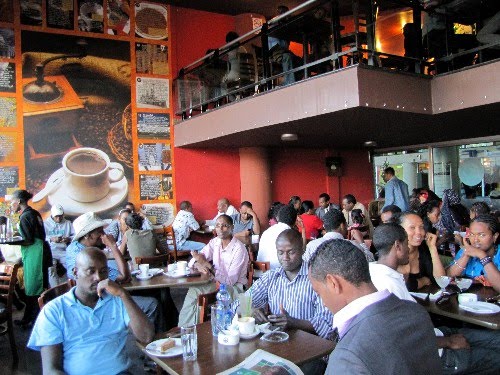 Ok, so one of the downsides of Ghana was the complete lack of coffee. For those of you that know me these days, you know my afternoon coffee is like a shot of happy juice in my day. While I tend to run pretty well on adrenaline on these trips I still missed coffee. So arriving in Ethiopia was a wonderful next step. Here everyone drinks these little macchiatos.
  For those of you that don’t know that is an espresso with milk and lots of foam. Plus here there is an added bonus, the milk is thicker and creamier and just better! They are so good that I have been stopping more than once a day. It’s a fun place to sit in the sidewalk cafes amongst all the men. I think they just look at me like another crazy “ferengi” (foreigner) since there are very few other women around. Also there seems to be a middle class growing "Starbucks" cafe culture. Check out the impostor.
Reflections on traveling to Africa for work
Writing about the countries I visit in Africa is so much harder than other places I have been. First off, my visits are pretty packed with Princeton in Africa partner site visits, time with current and past Fellows and trying to keep up with emails and Princeton in Africa work from the US versus trips to the various tourist sites. What that tends to mean is that I don’t have a lot of extra time to sit back and think about what I am seeing. Usually when I travel for pleasure, I try to read both fiction and non-fiction books about the country I am traveling in. I try to read the local paper every day and get a sense about the current state of affairs of the country I’m in. Unfortunately on my work trips I don’t always get a chance to do this. Traveling to 3 or 5 countries in 5 weeks each year usually means I hardly know what is really going on and instead just get a chance to dig deep into a particular issue by hearing one of my Fellows daily experiences at work or visiting an organization that Princeton in Africa partners with. I’ve gotten to learn lots about the treatment of HIV, particularly in youth, issues in Africa education in a few countries, issues concerning drought and successful strategies to handle it like building rainwater harvesting systems or developing better local solutions for filtering existing water sources and I’ve certainly gotten to hear a lot about humanitarian aid and food security.
Subscribe to:
Posts (Atom)