Search This Blog

Showing posts with label Africa. Show all posts

Saturday, September 24, 2011

Meeting the President of Guinea during UN General Assembly Week in NY

Suzanne and I get to meet Alpha Conde, the President of Guinea
Lots of you know that my favorite NY event of the year is the UN General Assembly. 193 world leaders came to town this year and I did my annual session of stalking. This year I did really well!

Somehow I befriended some Guinean's in the Waldorf lobby and told them I'd love to meet their new President. An hour later I managed to join a crowd of 25 prominent Guinean's from DC, Boston and NY up in the country's suite and was part of a surreal time mixed with referential treatment, lots of Islamic prayers and genuine love of their country all in a language I didn't speak. And mixed in all that was real pleasure that my friend and I cared about their country.

Sunday, March 27, 2011

Photos from Lalibela, Ethiopia

Lalibela, a World Heritage site, undoubtedly ranks among the greatest religious-h­istorical sites in the Christian world.

An ancient world, including 11 magnificent, medieval, rock-hewn churches, dimly lit passageways, hidden crypts and grottoes, was carved into the red volcanic rock underlying this remote Ethiopian town almost a millennia ago by the Zagwe dynasty. Today that world remains, frozen in stone. -Lonely Planet


Wednesday, March 02, 2011

Ethiopian Coffee

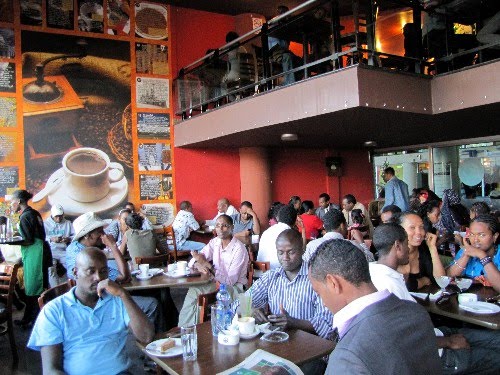
Ok, so one of the downsides of Ghana was the complete lack of coffee. For those of you that know me these days, you know my afternoon coffee is like a shot of happy juice in my day. While I tend to run pretty well on adrenaline on these trips I still missed coffee. So arriving in Ethiopia was a wonderful next step. Here everyone drinks these little macchiatos. For those of you that don’t know that is an espresso with milk and lots of foam. Plus here there is an added bonus, the milk is thicker and creamier and just better! They are so good that I have been stopping more than once a day. It’s a fun place to sit in the sidewalk cafes amongst all the men. I think they just look at me like another crazy “ferengi” (foreigner) since there are very few other women around. Also there seems to be a middle class growing "Starbucks" cafe culture. Check out the impostor.

Reflections on traveling to Africa for work

Writing about the countries I visit in Africa is so much harder than other places I have been. First off, my visits are pretty packed with Princeton in Africa partner site visits, time with current and past Fellows and trying to keep up with emails and Princeton in Africa work from the US versus trips to the various tourist sites. What that tends to mean is that I don’t have a lot of extra time to sit back and think about what I am seeing. Usually when I travel for pleasure, I try to read both fiction and non-fiction books about the country I am traveling in. I try to read the local paper every day and get a sense about the current state of affairs of the country I’m in. Unfortunately on my work trips I don’t always get a chance to do this. Traveling to 3 or 5 countries in 5 weeks each year usually means I hardly know what is really going on and instead just get a chance to dig deep into a particular issue by hearing one of my Fellows daily experiences at work or visiting an organization that Princeton in Africa partners with. I’ve gotten to learn lots about the treatment of HIV, particularly in youth, issues in Africa education in a few countries, issues concerning drought and successful strategies to handle it like building rainwater harvesting systems or developing better local solutions for filtering existing water sources and I’ve certainly gotten to hear a lot about humanitarian aid and food security.

Monday, February 14, 2011

Photos from Ghana


Awaiting an incoming fishing boat at Krokrobite Beach in Ghana


The fisherman's beach in Cape Coast
It was an amazing hive of activity
Faces at Anamabo Beach

Friday, March 05, 2010

Reflections on my trip


After 4 weeks in 5 countries visiting various NGOs doing a variety of work related to nutrition, public health and HIV/AIDS, education and sustainable development, I reflect back on many of the same questions that always fill my mind after a trip to Africa. The biggest ongoing one is “does aid work?” Of course, I can’t answer that question here, but I can say I leave Africa less cynical this time than in the past. I visited valuable programs that are making very positive impacts on individual’s lives. I met passionate people running programs that genuinely believe they are doing good work and have bright attitudes about the future.

In fact, that is the funny thing about my job at Princeton in Africa. Each year, through 25 different Fellows experiences, I get to hear many stories that don’t make it into the mainstream press. Although they work face to face with poverty, disease and conflict, they also work face to face with real people and programs that serve them. They tell of little ways life improves or the way local people help themselves through the tough times. What is always clear to me is that Africa is a much more humane place than the news covers. I never see the “dark continent”. Instead I see rich, deep smiles of real people.

I hope this brighter feeling means there is something changing on the continent. After all the Newsweek cover last week called Africa the next Asia and local magazines are feeling bullish on the prospects of many countries.

How Africa is Becoming the New Asia


http://www.newsweek.com/id/233501


Africa: 5 Countries in 4 Weeks


I know most Americans know nothing about Africa and I never even know where to start when trying to share my experiences, but if you have read this far I hope you will read some more and learn about the tremendous variety between regions, nations and cultures. I went to five countries and each one is different. Here are a few things I will miss about them?

Senegal


The class of the beautiful set of people who have melded the French cultural swish with the great African dignity.

The strong sea breeze.

Mini omelet stands all over and Nescafe carts plying the streets.

Benin

The colorful men in traditional dress keeping culture alive. Women often wear traditional dress but seeing men in bright colored patterns was amazing.

Wednesday, February 24, 2010

Dakar Senegal - The Second Time Around


After two weeks in Benin and Burkina Faso, Dakar felt like another planet. Beautiful palm promenades by the sea, fancy hotels, big houses... Dakar is much more developed and much richer. There are plenty of spots of poverty, but what became clear to me was its sense of style and cosmopolitan feel.

One clear fact is that Senegalese people are beautiful, drop dead beautiful. Tall handsome men. Gorgeous women. And Dakar knows how to show them off.

I had two separate daylong visits where Callie, a Princeton in Africa Fellow who is working for the UN World Food Program in their West Africa regional office showed me around. I visited her office, met with her boss, learned more about the work WFP is doing in the region. Afterwards Callie and I spent time walking around downtown and seeing the sites. Dakar is on a peninsula and has beautiful blue water all around it and tropical sea breezes.

Road Trip to Gorum Gorum in Northern Burkina Faso

While I was visiting, I packed up three Princeton in Africa Fellows, the two who live in Ouaga and the one I had been travelling with from Benin and we journeyed 6 hours up North to the edge of the Sahara desert to Gorum Gorum, where a huge weekly market takes place. It is attended by many of the nomads in the region. Here the faces of Tuaregs and Fulani’s brightened up the view. It was a feast of color and tradition. The livestock market was packed with men pocking and prodding goats and cattle since these nomads are herders. On all my drives in Burkina Faso the roads were lined with beautiful sprawling dry desert lands that were dotted with heads of goats, donkeys and cattle across the red clay soil.

I am a people watcher and experiences like Gorum Gorum are my candy. Seeing such a diverse sets of faces and meeting people from all over is why I travel.

Here are a few photos:


Tuesday, February 23, 2010

Photos from Northern Burkina Faso


Ouagadougou, the capitol of Burkina Faso

My multi-day road trip filled with long bus rides led me to Ouagadougou, Burkina Faso, the capitol city. Here two Princeton in Africa Fellows work at 2iE, an engineering graduate school dedicated to sustainable solutions for Africa’s problems. I was able to visit the school and also explore the city.

Ouaga, doesn’t have a lot of big sites to see, but Burkina Faso does have a vibrant culture and is often referred to as the friendliest place in Africa. My free time was spent walking around the markets of downtown people watching as I dodged hundreds of motos and bicycles that ply the streets.

Saturday, February 20, 2010

Ouidah, Benin – the birth place of Voodoo

Ouidah, Benin on the Western Coast of the country is the birthplace to voodoo and much of the country believes in various forms of animist religions. Small fetishes (voodoo offerings to the gods) can be seen above and beside doorways and larger fetish temples exist throughout the country. The most obvious fetishes are the remnants of blood and chicken feather that can be seen in many places.

Although I can’t begin to understand the religion and its practices, I did come upon one annual ceremony and able to view the activities and dances that followed. I also stopped by the more touristy Temple de Pythons, where, for a few cfas, they will drape you with live pythons and take your photo. Pythons are a big thing in Benin and when I was up north, far from the Python Temple, a kid I befriended saw the picture of me with them he was so shocked that he made everyone on the street come look at the photo and all their eyes opened wide.

In the North in the Tata Somba country, I found my favorite fetishes. Outside the local houses there are many different sized mounds. Each mound represents a member of the family. Prayers and sacrifices are made on these mounds to protect the people. The part I found most touching was that they said that even if a family member moved far away to Europe and such, the family could continue to pray for and protect them at home.

Benin and Its Slave Trading Past

Gate of No Return - A memorial to the slave port that was on the shores of Benin
Benin also was the home of a major slave trading kingdom in Africa, the Dahomey Kingdom. Their rule spread over areas we now call Togo, Benin, Nigeria and Burkina Faso. Selling slaves to Europeans in exchange for weapons helped them build their strength. The weapons fueled their ways and the slaves they sold were often their prisoners of war. The memorials to the slave trade in Ouidah are vivid. First one starts at an old Portuguese fort where slaves were exchanged. Now there are photos and art work that remind you of the terrible injustices done there and speak to the strength of the Dahomey Kingdom and African’s direct involvement and profit in the slave trade. Along the 3km route to the water where slaves were marched, there are statues and memorials. There is a tree, the Tree of Forgetting, where slaves walked around 9 times in order to purge their memories of Africa before they got on the boats and then there was another tree, the Tree of Return, marking the point of last goodbyes. By turning three times around the tree, slaves could ensure that their spirits would return to their homeland after death. Along the route one is reminded of the incredible brutality and all the efforts made to break everyone’s spirits and also all the people who died before even setting off on the journey.

Wednesday, February 17, 2010

Photos of Benin

Children waiting for lunch at a school feeding program sponsored by the UN World Food Program


Wednesday, February 10, 2010

Quick stop Dakar, Senegal

Three days of snow delays cut my weekend visit to Dakar to an 7 hour jaunt. Thanks to a Princeton in Africa Fellow, I jam-packed the day and at least got to see some stuff. We had breakfast at a rooftop restaurant with a wonderful view of the coast line and the cosmopolitan city below. I got to visit World Food Program and meet her boss. Then we spent a few hours walking around downtown and topped it off with lunch at the French Cultural Center an amazing green oasis in the middle of town.

I certainly wasn’t in Dakar long enough to form major impressions, but first I want to say that it is GREAT to be back in Africa. There is just a feeling here that makes me feel at home. Instantly I feel relaxed and welcomed. I just can’t get enough of the big smiles and friendly faces.

This is my first trip to West Africa and I can tell its going to live up to my expectations. The thing that makes this city stand out from other places I have been is the colorful wardrobes the men wear. All over the world women continue to wear traditional dress and in Dakar they do too. The colors and fabrics are awesome. But usually men wear the same clothes no matter where you are, but not in Dakar. Many of the men are colorfully dressed too. Long robes, impressive embroidery and a variety of hats dot the sidewalks. The abundance of color here gives India a run for its money.

Unfortunately I have no photos yet, but hopefully I’ll get time to take some on the other day layover I have there.